
Laura Hospes
‘Rebirth’
24 October – 28 November, 2026
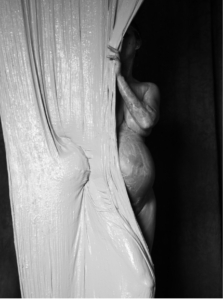
Laura Hospes (1994) has been documenting herself through photography since the age of sixteen. For her, photography is a means of accepting and processing the struggles in her life, but also of seeking connection with others. In her self-portraits, Hospes makes visible what is happening within her. The camera offers her comfort and allows her to capture her inner world. Her images are intense and compelling, offering a glimpse into the life of a woman struggling with depression and anxiety. Her early work reflects her well-being and her personal reality.
That reality changed profoundly when Hospes became pregnant. During pregnancy, the body is no longer solely one’s own domain; instead, it becomes a shared space in which care takes center stage. The body assumes a new responsibility: it no longer carries only itself, but also the life of another. For Hospes, her own body ended on the inside, at the point where the outside of her son began: at his skin.
During pregnancy, two bodies temporarily merge. Yet this merging is ambiguous: as the bond grows, the body is simultaneously preparing to separate the two lives. Each week brings the birth closer, and with it the moment when mother and child physically part ways. In this process, you are shaped and reshaped, while continuing to shape yourself.
In Rebirth, Laura Hospes captures this new, temporary reality through a series of self-portraits and line drawings. In images where her body disappears beneath a veil, is covered in white paint, or is reduced to a single line, she explores what it means to get to know oneself anew. Her work reveals how pregnancy brings about not only physical change, but personal transformation. It introduces a new dimension of self-care: caring for yourself while simultaneously caring for another. A reality in which you are never entirely alone again.
With Rebirth, Hospes builds on the personal exploration that also formed the focus of her earlier exhibition Phantom Itch (2024) at LANG. Whereas her earlier work centred on her experience of psychological vulnerability, Rebirth takes pregnancy as the starting point for a new phase in her practice. Her changing body and the bond with her son raise new questions about identity, autonomy and self-care. The camera remains a means of exploring and documenting her experiences, even as her reality continues to evolve.
While still studying at the Fotoacademie, Hospes won the LensCulture Emerging Talent Award, giving her career an early boost. Her work attracted international media attention and was featured in publications including The Huffington Post, The Daily Mail and Yahoo. After graduating with distinction, she received several awards and grants, including the Jacob Riis Documentary Award, the Young Masters Art Prize, the Zilveren Camera, SO2015 and the Prix de la Photographie. Her work has been exhibited internationally, including in Amsterdam, San Francisco, Venice, New York, London, Arles, Paris and Berlin. Her work is held in national and international private and public collections, including the Fotomuseum Den Haag and the AkzoNobel Art Foundation.
She previously published the photobook UCP, named after the psychiatric ward where she stayed. Published by Lecturis Publishers, the book was named one of the best photobooks of 2016 by de Volkskrant and was shortlisted for The Best Dutch Book Designs 2016. Both in UCP and in her exhibitions, Hospes explores how photography can create space for personal experiences that are not always easy to put into words.